The Stressed Bee: Grounding Tools for Sensory Overload & Focus
*This post contains affiliate links. As an Amazon Associate, I earn from qualifying purchases. Thank you for supporting our little grove!
Does your child ever seem to be… vibrating?
You know the look. They are moving fast, jumping from toy to toy, talking a mile a minute, but they can’t seem to actually land on anything. Their thoughts seem frantic, their body is restless, and they are easily frustrated by the smallest things.
In the Little Golden Grove system, we call this The Stressed Bee.
When a child is in "Bee Mode," they aren't necessarily being naughty, and they usually aren't angry (that’s the Bear). They are overstimulated. Their nervous system is overwhelmed by the "noise" of the world, and they are buzzing around trying to find a safe place to settle.
As an unschooling mom of three boys, I see this state often. And I’ve learned that the way we handle The Bee is completely different from how we handle the other animals.

The Science: Why "Calm Down" doesn't work
When a child is suffering from sensory overload or anxiety, their brain is in a high-alert state. Telling a buzzing child to "sit still and be quiet" is fighting biology. Their body is buzzing because it is looking for a signal.
The Bee doesn't need stillness forced upon them. The Bee needs a Job.
Specifically, the Stressed Bee needs to "Narrow the Field." By giving the brain a singular, intricate task to focus on, we help the "swarm" of thoughts quiet down until there is only one clear thing left to do.
Precision vs. Power: The Secret to Regulation
This is the core philosophy that changed how I parent my boys:
The Angry Bear needs POWER. (Pushing, pulling, heavy lifting, big movement).
The Stressed Bee needs PRECISION. (Sorting, threading, balancing, observing).
If you give a Stressed Bee a "big" movement activity (like running laps), it might actually ramp them up further. But if you give them a tiny world to control, their nervous system naturally down-regulates.
Here are 6 nature-inspired Social Emotional Learning (SEL) activities designed to help your Stressed Bee find their flower and land.
6 Precision Activities
for kids
🌿 Outdoor Grounding Activities
Best for: When the "zoomies" hit or the environment is too loud.
1. The Flower Zoom: Give your child a magnifying glass (or just make a circle with your fingers for a "spy eye") and challenge them to find one single flower or leaf.
The Mission: Count the petals. Find three tiny veins. Spot a bug.
Why it works: It forces the eyes to converge on a single point, which signals safety to the brain.
2. The Pollen Trail: Use a stick to draw a winding, twisty line in the dirt. Challenge your child to walk exactly on the line, heel-to-toe, without "falling off."
The Mission: Keep your feet on the pollen path!
Why it works: Balance requires deep internal focus (proprioception), which pulls energy out of the anxious thoughts and into the body.
3. Leaf Sorting: Gather a handful of random leaves. Ask your child to sort them... by size, by shade of green, or by texture (crunchy vs. soft).
The Mission: Create order out of chaos.
Why it works: Classification is a calming cognitive task. It tells the brain: "I can organize my world."
🏠 Indoor Calm-Down Corner Ideas
Best for: Rainy days, transition times, or before bed.
4. The Hive Sort: Set up a simple sensory bin (rice, beans, or pasta). Give your child a pair of tweezers or tongs and ask them to pick out specific items (like "pollen" pom-poms) and move them into a cup.
The Mission: Rescue the pollen without touching the rice!
Why it works: Fine motor work engages the hands and eyes intensely, leaving no room for "buzzy" background thoughts.
5. Rhythmic Chimes: (The Silence Game) Ring a single chime, strike a triangle, or flip a rain stick. Ask your child to listen like a hawk and raise their hand the exact second the sound stops completely.
The Mission: Catch the silence.
Why it works: It turns "listening" into a game rather than a command, tuning out auditory clutter.
6. The Mindful Bubble: Challenge your child to blow a single bubble and keep it in the air for as long as possible using only their gentle breath (no hands allowed!)
The Mission: Keep the bubble floating.
Why it works: This is a stealthy way to practice breath-work. To keep the bubble afloat, they have to exhale slowly and steadily, which directly activates the parasympathetic nervous system (the "Rest and Digest" mode).
🎵 A Song for the Bee Sometimes, the easiest way to shift the energy is through music. We created this "Anthem for the Bee" to help bridge the gap between the storm and the calm. Play this when you need a reset.
🛠️ Tools for the Bee
If you are looking to stock your Calm Down Corner specifically for the "Stressed Bee," skip the punching bags and pillows.
Remember, the Bee needs precision, not power. We want tools that encourage visual tracking, fine motor skills, and "narrowing the field.
1. Liquid Motion Bubblers (The Visual Anchor): Unlike a glitter jar which you have to shake (adding energy), a liquid bubbler is passive. Watching the colored drops slide down requires the eyes to track slowly and steadily, which naturally slows down the breathing.
2. Paint By Sticker Books: It provides the creative satisfaction of art without the sensory mess of paint or the frustration of drawing. It requires intense focus to match the numbers and align the stickers, which forces the brain to block out the "swarm" of background thoughts.
3. Noise Reduction Earmuffs: Sometimes the "Buzz" is literal—the room is just too loud. Giving a child a pair of comfortable, kid-safe earmuffs gives them instant control over their environment. It doesn't silence the world, but it turns the volume dial down from an 11 to a 4.
4. Wooden Sorting Trays & Tongs: Montessori parents know the power of a transfer activity. A simple wooden sorting tray with a pair of large tweezers turns a pile of wool balls or rocks into a grounding mission. The act of squeezing the tongs provides just enough hand tension to release stress, while the sorting organizes the mind.
Finding Your "Flower"
The goal isn't to stop the Bee from flying - it's to help them find a place to land.
Whether it’s weaving sticks in the backyard or sorting Legos by color on the rug, we are looking for activities that "shrink the world" down to a manageable size.
When we provide a singular point of focus, we help our children move out of the overwhelming swarm and back into the quiet of the clearing.
Do you have a Stressed Bee or an Angry Bear?
Sometimes it’s hard to tell the difference in the heat of the moment.
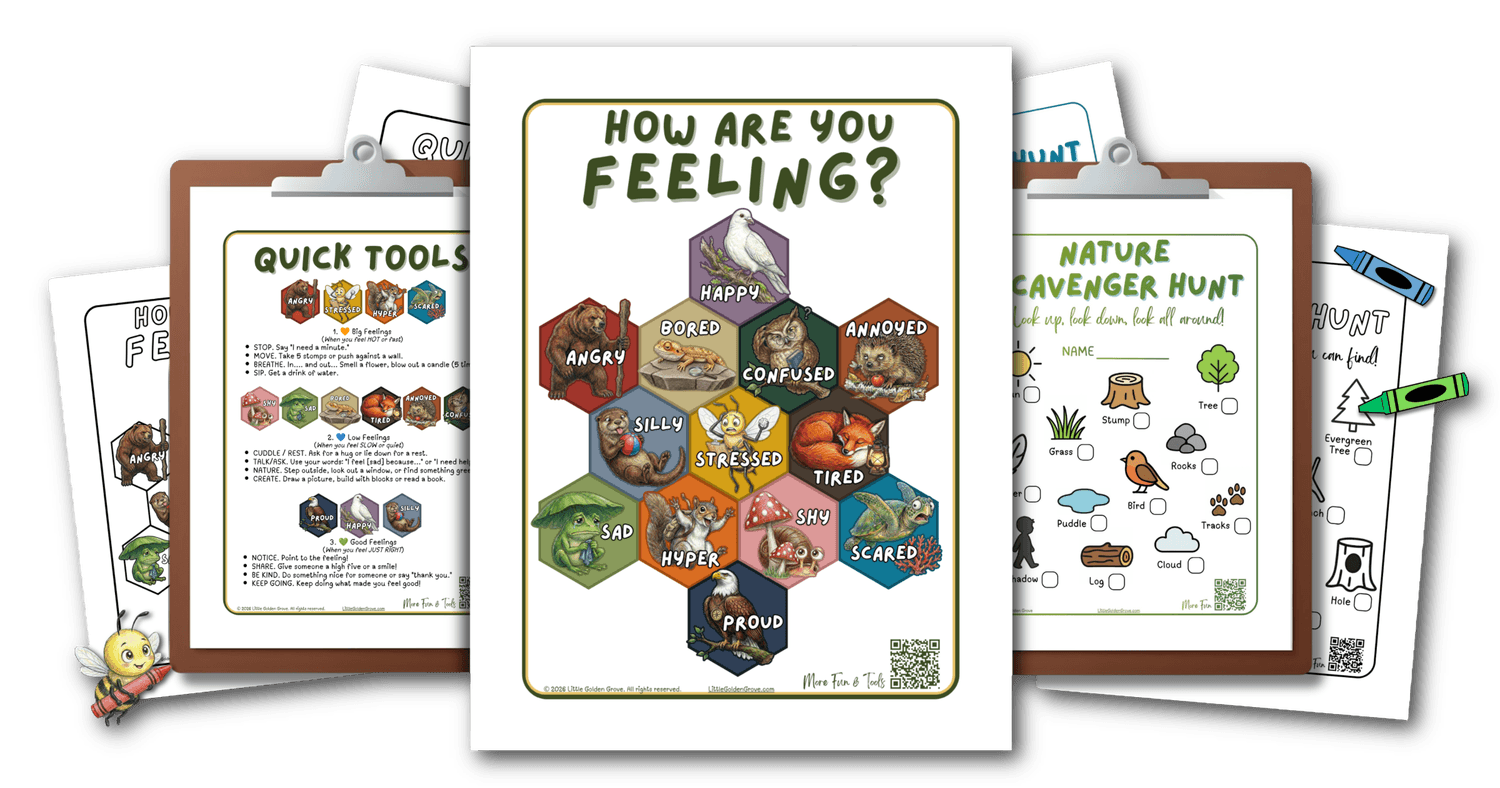
I created the Little Golden Grove Emotional Regulation Bundle to help kids identify exactly which animal they are feeling. It includes our Interactive Emotions Chart so your child can simply point to "The Bee" when things get too loud, giving you the signal to switch to "Precision Mode" immediately.
Let’s help our little Bees find their focus, one flower at a time.

Stay Connected!
Grab our signature nature scavenger hunt and get occasional updates on new nature-based tools & resources!